California State University Northridge Athletics
CSUN Athletics Hall of Fame
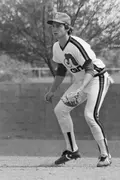
Perry Husband
- Induction:
- 2004
- Class:
- 1984
Perry Husband was inducted into the CSUN Athletics Hall of Fame in 2004. Husband lettered three seasons for the CSUN Baseball team from 1982 to 1984.
A career .328 hitter, Husband hit a personal-best .351 as a senior, capped off by a College World Series MVP award. A member of one of the top teams in Matador history, Husband went on to play professionally in the Minnesota Twins organization. But his contributions to the game were far from done following his retirement. After taking up coaching, Husband has since become a prominent figure in the world of baseball science.
Husband left CSUN temporarily, deciding to play for Antelope Valley College, where he hit .439 for the season, including setting a national record with a 32-game hitting streak. Becoming the top hitter in the state, his accomplishments drew the attention of a familiar face back in Northridge.
With newfound confidence, Husband returned to play for Bob Hiegert and CSUN and soon earned a starting job at second base. As a sophomore, Husband hit just under .300 in helping CSUN advance to the 1982 postseason. Under Hiegert, the Matadors were no strangers to the NCAA Tournament. A perennial Division II title contender, CSUN also held its own against the best Division I teams. In 1984, the team fielded a loaded squad, led by offensive machine Mike Solomon, who hit above .400. Husband was third on the team in batting (.394), racking up 92 hits.
Husband was also a two-time All-District VIII selection, posting 92 hits in 1984.
After retiring from baseball, Husband took up instruction as a golf teacher and a baseball coach in the American Legion and at Antelope Valley College. He also opened and operated a baseball academy in his hometown of Quartz Hill. It was in his instruction that he developed a passion for baseball science.
Husband introduced a new way of approaching pitching and batting. His work led to the theory of effective velocity (EV), which studies pitch speeds and how location changes the reaction time for hitters.
In his testing, he enlisted the services of Jay Bell, who at the time was playing for the Arizona Diamondbacks. The testing measured whether Bell was early or late and up or down on contact when trying to hit the ball to a location. Husband also measured Bell's timing with his foot and the effectiveness of hitting the ball to different locations. He went on to work with Boston Red Sox hitting coach Tim Hyers, testing 200 high school players to further examine effective velocity. His testing included keeping the pitch speed constant but moving the ball to different points of the strike zone to see how effective a swing the batters could produce.
Husband, who graduated from CSUN in 1984, has since become a pioneer in the world of baseball science. He has authored numerous books further detailing his research and metrics. His science has also since been adopted by current and former MLB coaches and players.
A career .328 hitter, Husband hit a personal-best .351 as a senior, capped off by a College World Series MVP award. A member of one of the top teams in Matador history, Husband went on to play professionally in the Minnesota Twins organization. But his contributions to the game were far from done following his retirement. After taking up coaching, Husband has since become a prominent figure in the world of baseball science.
Husband left CSUN temporarily, deciding to play for Antelope Valley College, where he hit .439 for the season, including setting a national record with a 32-game hitting streak. Becoming the top hitter in the state, his accomplishments drew the attention of a familiar face back in Northridge.
With newfound confidence, Husband returned to play for Bob Hiegert and CSUN and soon earned a starting job at second base. As a sophomore, Husband hit just under .300 in helping CSUN advance to the 1982 postseason. Under Hiegert, the Matadors were no strangers to the NCAA Tournament. A perennial Division II title contender, CSUN also held its own against the best Division I teams. In 1984, the team fielded a loaded squad, led by offensive machine Mike Solomon, who hit above .400. Husband was third on the team in batting (.394), racking up 92 hits.
Husband was also a two-time All-District VIII selection, posting 92 hits in 1984.
Husband introduced a new way of approaching pitching and batting. His work led to the theory of effective velocity (EV), which studies pitch speeds and how location changes the reaction time for hitters.
In his testing, he enlisted the services of Jay Bell, who at the time was playing for the Arizona Diamondbacks. The testing measured whether Bell was early or late and up or down on contact when trying to hit the ball to a location. Husband also measured Bell's timing with his foot and the effectiveness of hitting the ball to different locations. He went on to work with Boston Red Sox hitting coach Tim Hyers, testing 200 high school players to further examine effective velocity. His testing included keeping the pitch speed constant but moving the ball to different points of the strike zone to see how effective a swing the batters could produce.
Husband, who graduated from CSUN in 1984, has since become a pioneer in the world of baseball science. He has authored numerous books further detailing his research and metrics. His science has also since been adopted by current and former MLB coaches and players.
Wednesday, September 16
Thursday, September 03
Wednesday, August 26
Friday, February 13