California State University Northridge Athletics
BLOG: Tree Planting and Oyster Farming in Costa Rica
6/12/2017 12:30:00 PM | Men's Volleyball, Women's Water Polo

On Thursday, June 1, 14 CSUN student-athletes arrived in Costa Rica for a two-week service trip. A diverse group of student-athletes representing different teams and class years will spend 14 days volunteering, learning about Costa Rica's economy, culture and environment and growing their camaraderie as Matadors.
During its journey, the group will visit a cloud forest, volunteer with a community water association, spend time at a tropical research station, learn about reforestation and much more. Student-athletes will be blogging about the trip for GoMatadors.com.

Women's water polo senior Carly Wickman and recent men's volleyball graduate Mitch Theisen blog their experiences.
Carly:
It's been over a week since we have arrived in Costa Rica and it has been nothing short of amazing. From beautiful scenery, nice weather and all the friendly people we've met along the way, I have learned so much about the lifestyle and country of Costa Rica.
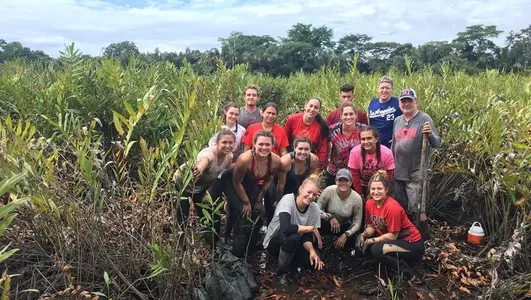
We had to wake up early one morning because the day's service included planting mangrove trees. We had to start early while the tide was low because if we waited until later in the day, the whole area where we were planting would be under water. You're probably wondering how exactly you plant mangrove trees...so were we. Even our tour guide wasn't so sure how we would be doing it, so waking up this morning we all had no idea what was in store.
We arrived to Corcovado National Forest, put on our rubber boots and trudged through the mud to the baby mangrove trees. We had to carry the baby mangrove trees about 300 feet to the location where we would plant them in rows of about 30. (Keep in mind it was humid and so muddy our boots were getting stuck with almost every step we took.)

With all of us being athletes and coming from different sports, it was awesome how we were able to work together as a team to plant the mangrove trees. Our teamwork is what helped us finish in about 2.5 hours even though it was expected to take longer.
At the end we may have been exhausted but this service was very rewarding. We learned that the mangrove trees are an important nesting site for certain animals such as fish and birds. The mangrove trees are important for the ecosystem and provide a shelter for the animals where they can mate and provide protection for them and their offspring.
Overall this experience has been great. Getting to know this group of student-athletes, Ed, Ashley and the people of Costa Rica has been so exciting and I'm looking forward to our last week of adventures!
Mitch:
Sunday was one for the books! We started off the morning with 6 a.m. yoga in the pouring rain (gotta love the rainforest climate) lead by the great Dr. Ashley Samson. Early morning yoga and running with the soccer girls has been keeping me in shape throughout our trip.
Now for my favorite part of the trip so far. The day's volunteer work was especially important to me because it was directly related to what I intend to study post-grad! We spent the morning working on an oyster farm that was run by the same organization as the group that helped us plant mangrove trees a couple days back. This oyster farm is a sustainable aquaculture system that provides food and economic benefit for the local community. The best part of this system is that it does not harm the environment of the ocean and protects the local wildlife. Our tasks included pulling in the oyster cages, cleaning/separating the oysters and treating them. At the end of the day, we were able to complete two days' worth of work in a matter of hours!
The oyster farm was located in the quiet waters of a protected gulf area of the Osa Peninsula. I was extremely enthusiastic because much of our work was done out in the ocean. There is something about being out on the open water that makes

me feel so at peace. I am extremely grateful that we worked with this organization, and I even received contact info from the group regarding doing work with them in the future. I plan to use my undergraduate degree in Nutrition/Dietetics to study sustainable food systems, and after a lot of talks with Ed and Ashley on this trip, possibly even obtain my PhD! My goal is to change the way people eat by changing the way we produce. I learned a lot from the local people (thank you, Paula, for translating) about their means of food production.
If the morning wasn't enough, we spent the rest of the day doing what I do best: relaxing at the beach. After lunch at the research station we made our way back to Puerto Jimenez for some free time. Most of this afternoon included regaining touch with the world (finally some working wifi!) and reading by the ocean. Later on, a couple of us rented kayaks, and we found ourselves out on the open water again. We ended up seeing a pod of dolphins swimming within feet of us and enjoyed another refreshing rain shower on our voyage back in.
After that, the rest of the night included dinner, going through the day's photos and hanging out in our rooms. My only complaint is that we're another day closer to leaving this beautiful country! I'm excited for yet another day in paradise. ¡Adios y pura vida!
Previous Costa Rica Blog Posts:
Brenden Scott and Ariana Tran: Matadors Arrive in Costa Rica
Caroline Gilling and Paula Abellan Garcia: Student-Athletes Prepare for Costa Rica Service Trip