
California State University Northridge Athletics
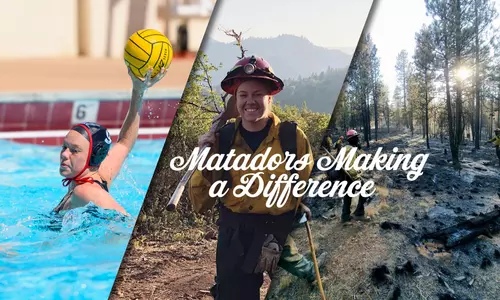
Matadors Making a Difference: Ashlee Sellung
10/1/2020 10:05:00 AM | Women's Water Polo
Ashlee Sellung had different ideas of how she would spend her fall this year.
A former three-year letterwinner with the CSUN water polo team (2017-19), Sellung graduated with a degree in political science this past May and was studying to go to law school when she heard about the opportunity to become a wildland firefighter.
Major wildfires have ravaged many areas across the Western United States this summer, with Oregon as one of the hardest-hit states. This year has been one of the most destructive fire seasons in Oregon history with more than one million acres of land burned.

Sellung, who was on leave from her job at 24-Hour Fitness because of COVID-19, received a fateful call from her co-worker in August about the chance to fight fires in Oregon. Her co-worker had a contact in Grants Pass, Ore. and asked Sellung if she wanted to come along and become a firefighter.
To say the least, firefighting was not part of her immediate post-graduation plans but she was interested in the field and entertained the offer.
"I always thought it would be really cool to do some kind of job in public service," said Sellung. "I had in the back of my mind that a firefighter would be really cool but it never seemed like a practical job for me. It seemed like something that everybody else does. When this opportunity came about, it felt so right and I know it sounds cheesy, but I felt like I needed to answer the call."
Within hours, Sellung gathered her belongings and made the drive down to Oregon. A day after arriving, she began her training.
The training consisted of a week-long classroom course along with required practical work before she was certified. However, she needed to respond to a live fire to officially become a wildland firefighter.
Sellung responded to the Green Ridge fire, located about 12 miles northwest from Sisters, Ore. The fire had been active since the middle of August and had burned over 4,000 acres of land over a two-week period.
"I was very fortunate because my first fire call was not as intense as could have been," said Sellung. "My duties essentially consisted of a lot of clean up because a lot of the scarier parts of the fire such as the initial attack had dissipated by the time we got called up."

The only female in a 20-person crew, Sellung was responsible for clean-up duties on the Green Ridge fire as well as scanning different burn zones and eliminating any heat found underground. When digging up the heat, she then could expose it to water to prevent the remaining embers from flaring up and spreading again.
"It was draining, both emotionally and physically and I really questioned what I was doing up here in the beginning," said Sellung. "Although I was around 18 different strangers, my experience was very pleasant because everybody here has been very supportive of me and has given me a ton of guidance, especially the veteran firefighters that come back every season."
As of mid-September, Sellung has responded to three fires in Oregon, with her third fire stretching to over 15-plus consecutive days of work. Long days and long hours have become commonplace for her as she regularly works 18-hour shifts on a given day. Her workday could also stretch to a full 24-hour day.
After mainly working on clean-up duties on her first fire, Sellung has since responded to un-contained fires as well. For those fires, she has been responsible for building a fire line around the edge of the fire to prevent the fire from burning through a designated area.
"When you do that next to an active flame, it's called a hotline and you have to get a certain number of those on your experience docket to move forward in the ranks," said Sellung. "I have a couple of those under my belt, which is nice because they are hard to come by and can be really intense."
Armed with a fire-resistant uniform, Sellung often has to travel about eight miles up a mountain or a valley before arriving at her actual work. With her, she carries a pack weighing about 30 to 40 pounds. Her pack is armed with her hand tools and her fire shelter. The fire shelter comes into play in case the fire moves too close. If that happens, she could deploy the fire shelter and stay clear of the flames.

"Athletic training has definitely helped a lot with this," said the former water polo student-athlete. "It's a very dynamic job and that's what I like about it. Every day is different and every day is a surprise. You go in and hope for the best and prepare for the worst."
During her downtime, she stays with five other crew mates in a refurbished horse stable. She sleeps on a cot for a handful of hours at a time. The area also has an outdoor shower and a camp stove for cooking. The shelter has no heating or gas installation.
While she may not live in luxury, she is thankful for the support system that has guided her throughout her time in Oregon.
"One of the things that was really helpful was that I did this process with one of my good friends," said Sellung. "He's up here doing this with me along with all of these amazing guys. Even though they are strangers to me, we all have something in common that we're trying to do something bigger than ourselves and out of our comfort zone. We're trying to pay it forward and do what we can out here."
While working full-time as a wildland firefighter, Sellung has also kept busy by volunteering at a county fire station and with the Red Cross. Her work with the Red Cross has given her a chance to work at shelters where displaced families have relocated.
"I wanted to see both sides of the experience up here," said Sellung. "It's easy to get wrapped up in the job and the complexities of what we're doing and forget the big picture as well as the human side with those that have lost everything.

"It's helped in the job to push forward on the hard days and the long nights where I'm running on two hours of sleep," added Sellung.
The experience has changed Sellung's immediate plans for the fall as she may stay in Oregon for the remainder of the year. If she stays, she expects to work full-time at her fire station and earn her Firefighter 1 certification.
Law school is also still in the cards and she is intending to resume her LSAT preparation but this experience has given her a new perspective on her plans for the future.
"I was an aspiring lawyer and I'm still an aspiring lawyer who is open to doing more including coming here to become a firefighter during the fire season," said Sellung. "I'm just figuring it out as I go."
#UniteTheValley
A former three-year letterwinner with the CSUN water polo team (2017-19), Sellung graduated with a degree in political science this past May and was studying to go to law school when she heard about the opportunity to become a wildland firefighter.
Major wildfires have ravaged many areas across the Western United States this summer, with Oregon as one of the hardest-hit states. This year has been one of the most destructive fire seasons in Oregon history with more than one million acres of land burned.
Sellung, who was on leave from her job at 24-Hour Fitness because of COVID-19, received a fateful call from her co-worker in August about the chance to fight fires in Oregon. Her co-worker had a contact in Grants Pass, Ore. and asked Sellung if she wanted to come along and become a firefighter.
To say the least, firefighting was not part of her immediate post-graduation plans but she was interested in the field and entertained the offer.
"I always thought it would be really cool to do some kind of job in public service," said Sellung. "I had in the back of my mind that a firefighter would be really cool but it never seemed like a practical job for me. It seemed like something that everybody else does. When this opportunity came about, it felt so right and I know it sounds cheesy, but I felt like I needed to answer the call."
Within hours, Sellung gathered her belongings and made the drive down to Oregon. A day after arriving, she began her training.
The training consisted of a week-long classroom course along with required practical work before she was certified. However, she needed to respond to a live fire to officially become a wildland firefighter.
Sellung responded to the Green Ridge fire, located about 12 miles northwest from Sisters, Ore. The fire had been active since the middle of August and had burned over 4,000 acres of land over a two-week period.
"I was very fortunate because my first fire call was not as intense as could have been," said Sellung. "My duties essentially consisted of a lot of clean up because a lot of the scarier parts of the fire such as the initial attack had dissipated by the time we got called up."
The only female in a 20-person crew, Sellung was responsible for clean-up duties on the Green Ridge fire as well as scanning different burn zones and eliminating any heat found underground. When digging up the heat, she then could expose it to water to prevent the remaining embers from flaring up and spreading again.
"It was draining, both emotionally and physically and I really questioned what I was doing up here in the beginning," said Sellung. "Although I was around 18 different strangers, my experience was very pleasant because everybody here has been very supportive of me and has given me a ton of guidance, especially the veteran firefighters that come back every season."
As of mid-September, Sellung has responded to three fires in Oregon, with her third fire stretching to over 15-plus consecutive days of work. Long days and long hours have become commonplace for her as she regularly works 18-hour shifts on a given day. Her workday could also stretch to a full 24-hour day.
After mainly working on clean-up duties on her first fire, Sellung has since responded to un-contained fires as well. For those fires, she has been responsible for building a fire line around the edge of the fire to prevent the fire from burning through a designated area.
"When you do that next to an active flame, it's called a hotline and you have to get a certain number of those on your experience docket to move forward in the ranks," said Sellung. "I have a couple of those under my belt, which is nice because they are hard to come by and can be really intense."
Armed with a fire-resistant uniform, Sellung often has to travel about eight miles up a mountain or a valley before arriving at her actual work. With her, she carries a pack weighing about 30 to 40 pounds. Her pack is armed with her hand tools and her fire shelter. The fire shelter comes into play in case the fire moves too close. If that happens, she could deploy the fire shelter and stay clear of the flames.
"Athletic training has definitely helped a lot with this," said the former water polo student-athlete. "It's a very dynamic job and that's what I like about it. Every day is different and every day is a surprise. You go in and hope for the best and prepare for the worst."
During her downtime, she stays with five other crew mates in a refurbished horse stable. She sleeps on a cot for a handful of hours at a time. The area also has an outdoor shower and a camp stove for cooking. The shelter has no heating or gas installation.
While she may not live in luxury, she is thankful for the support system that has guided her throughout her time in Oregon.
"One of the things that was really helpful was that I did this process with one of my good friends," said Sellung. "He's up here doing this with me along with all of these amazing guys. Even though they are strangers to me, we all have something in common that we're trying to do something bigger than ourselves and out of our comfort zone. We're trying to pay it forward and do what we can out here."
While working full-time as a wildland firefighter, Sellung has also kept busy by volunteering at a county fire station and with the Red Cross. Her work with the Red Cross has given her a chance to work at shelters where displaced families have relocated.
"I wanted to see both sides of the experience up here," said Sellung. "It's easy to get wrapped up in the job and the complexities of what we're doing and forget the big picture as well as the human side with those that have lost everything.
"It's helped in the job to push forward on the hard days and the long nights where I'm running on two hours of sleep," added Sellung.
The experience has changed Sellung's immediate plans for the fall as she may stay in Oregon for the remainder of the year. If she stays, she expects to work full-time at her fire station and earn her Firefighter 1 certification.
Law school is also still in the cards and she is intending to resume her LSAT preparation but this experience has given her a new perspective on her plans for the future.
"I was an aspiring lawyer and I'm still an aspiring lawyer who is open to doing more including coming here to become a firefighter during the fire season," said Sellung. "I'm just figuring it out as I go."
#UniteTheValley
Players Mentioned

Defender
/ Women's Water PoloWednesday, September 16
Thursday, September 03
Wednesday, August 26
Friday, February 13