California State University Northridge Athletics
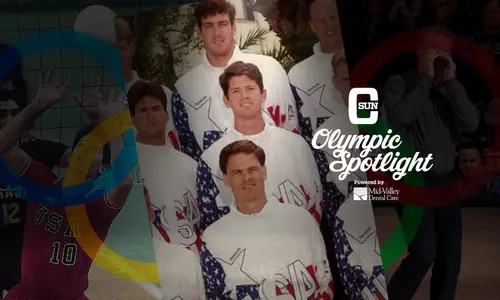
CSUN Olympic Spotlight - Jeff Stork
9/10/2020 9:48:00 AM | Women's Volleyball
With the Tokyo Olympics postponed until 2021 due to the coronavirus pandemic, GoMatadors.com takes a moment to look back at CSUN's history at the Olympic Games. In today's Olympic Spotlight, we take a look at three-time Olympian and current CSUN Director of Women's Volleyball Jeff Stork.
A 10-year member of the U.S. National Volleyball Team, Jeff Stork played on three Olympic teams for the United States, most notably the 1988 Gold Medal winning team.
Stork's Olympic volleyball career began at the 1988 Seoul Games under the direction of a familiar face. After three All-America seasons (1982-84) playing for head coach Marv Dunphy at Pepperdine, Stork was the setter for Dunphy's 1988 USA team that won Gold in South Korea.
His 1988 Olympic dreams almost turned into a nightmare as a back injury kept him sidelined for the first two matches. But he returned to spark Team USA's Gold Medal drive.
The U.S. dropped just three sets total in finishing the preliminary round (Pool B) with a perfect 5-0 record. The Americans swept Japan and topped the Netherlands (3-1) to open the tournament with Ricci Luyties handling the setting. Stork was back in the lineup against Argentina and the U.S. held on for a tough five-set win before sweeping both France and Tunisia.
"We played in Japan two weeks before the Olympics and I hurt my back," said Stork. "I came back and started the Argentina match which was obviously extremely significant for me. We won our next two matches and then beat Brazil in three sets in the semifinal which put us in the Gold Medal match."
In the semifinals, the U.S. took on Brazil which finished second in Pool A and the Americans won in straight sets, setting up a Gold Medal match against the Soviet Union. Stork helped the U.S. to a 13-15, 15-10, 15-4, 15-8 victory as the United States defended their Olympic Gold Medal.
 "We had played the Soviet Union so many times and knew them extremely well," Stork recalled. "We didn't play very well in the first set but we knew we were the better team and that it was really just a matter of time before we would take over and win the match."
Stork also recently reflected on his experience as a first-time Olympian.
"Playing in the Olympics was a little like the normal stuff in terms of volleyball but you know the world is watching so it's a heightened awareness of everything else going on," he said. "They wanted to show our matches in prime time back in the states and since there was such a time difference in Seoul, we played at odd times during the day. We would get up at 5 a.m. and go to bed pretty early to get our body clocks on the local schedule. There were such high expectations for us and we were expected to win, the team was incredibly focused on the task at hand."
Stork's second Olympic appearance came in Barcelona in 1992. The U.S. dropped a controversial opening-match against Japan before finishing 4-1 in pool play.
U.S. teammate and former CSUN All-American Bob Samuelson received a yellow card with Japan holding match point (14-13) in the fourth set. After a discussion, the referee ruled the set to continue and the U.S. came back to win the set 17-16 and the match 3–2 (15–8, 11–15, 10–15, 17–16, 16–14). Japan launched a protest immediately after the match ended and the following day a 25-man FIVB commission met for five hours to review the outcome and the result was a unanimous 23-0 vote to award the match to Japan.
 "We had played Japan 35 times prior to that Olympics and had dominated them all 35 times," said Stork. "That opening match was very heated and hotly contested with lots of arguing back-and-forth. Even though our win was ultimately overturned I think it really unified our team."
Undeterred by the decision, the U.S. went on to post 3-2 victories over both Canada and Spain before closing out pool play with wins over France (3-0) and Italy (3-1).
The Americans advanced to the quarterfinals where the United States defeated the Unified Team, 3-1 earning a berth in the semifinals against Brazil. The U.S. would drop a 3-1 decision in the semifinal match before claiming the Bronze Medal with a 3-1 victory over Cuba.
"After losing to Brazil, the Cuba match was really a hard one to play," recalled Stork. "We had won two consecutive Gold Medals and not playing for the Gold in Barcelona was difficult. We played hard but it was tough to play with a lot of emotion. Ultimately, the true character of our team showed up and we outlasted them to win an emotionally draining match. We had so much success over the previous eight years that it was a little disappointing to get the Bronze Medal, although I'm extremely proud to have it."
Stork's final Olympic appearance came at the Atlanta Games in 1996 when the host Americans finished fifth in Pool A. The U.S. swept both Poland and Argentina in its first two matches before dropping three straight to finish with a 2-3 record. With seven points, the U.S. came up one point shy of advancing to the final round of play.
"After my first two Olympics, Atlanta was quite a bit different," said Stork. "Other countries were getting better and better and started closing the gap. Our team was a mix of older players, like myself, and new players so the continuity wasn't as tight as it had been in the past. But it was a great group of guys."
Stork reflected on his Olympic career and volleyball in general.
"Volleyball, especially playing for the U.S. National team, has truly defined my life," he said. "In a lot of ways, how I'm perceived in the volleyball world is based on my Olympic and national team experience."
Stork, who was named to the USA Volleyball Men's (1978-2002) 75th Anniversary All-Era Team in 2003, is regarded as one of the game's all-time best setters and gained an international reputation for being calm under pressure. His highly technical approach allowed the American squad to maintain its No. 1 world ranking throughout the latter half of the 1980's. More recently, he was one of six legends inducted into the Volleyball Hall of Fame as the Class of 2012.
Stork, who enters his 19th season as CSUN's head coach in 2020, was also named to the Los Angeles City Section Hall of Fame Class of 2013 as a 1978 graduate of Taft High School.
Olympic Medal Record
 |
1988 Seoul | |
 |
1992 Barcelona |
#UniteTheValley